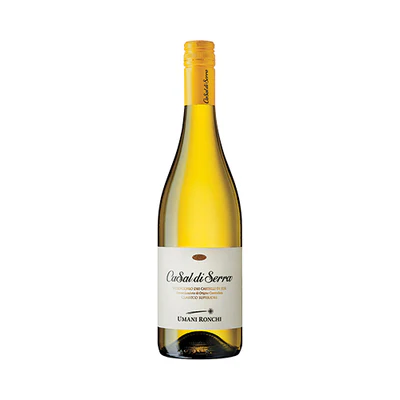
Umani Ronchi - Casal di Serra Verdicchio dei Castelli di Jesi Classico Superiore
Umani Ronchi got its start in the late 1950s, when Gino Umani Ronchi brought to life a small farm in Cupramontana, in Verdicchio Classico wine country. A few years later the producer was taken over by the Bianchi-Bernetti family, who acquired the brand and estate, bringing new entrepreneurial life to the venture. The property was reconstituted as a wine-growing estate on January 4, 1968, and just a year later its administrative headquarters were moved to Osimo, where they eventually opened a cellar for the production of Rosso Conero. During the same period, the Castelbellino cellar (used for making Verdicchio) was expanded.
In the early 1990s, Massimo Bernetti was joined by his son Michele, who’d recently graduated in economics and business, and had just finished an internship in London (where he served in the sales department of Umani Ronchi’s UK distributor). It was then that Massimo decided to further probe advanced cultivation and wine-making techniques, thanks in part to collaborations with experts from major university study centres.
Thus began the season of Michele, who with his sights set beyond regional borders decided to partner with Giacomo Tachis, a skilled winemaker known for celebrated wines like Solaia and Sassicaia. This change of direction brought great success: Champion Red Wine at the London’s International Wine Challenge, top 100 Wines from Wine Enthusiast for its Pelago, while its Cùmaro won a Gold Medal from Decanter, and their Verdicchio Vecchie Vigne 2009 won White of the Year from the Gambero Rosso, the most authoritative guide to Italian wine.
Umani Ronchi has had great success with international grapes but they also work with native varietals. Their CaSal di Serra Verdicchio is the result of selection massale for the vines, and wild yeasts for fermentation, with the intention of bringing the true flavours of the Montecarotto vineyards. Their Fonte del Re is made with Lacrima, a vine known since Roman times and now grown in tiny amounts around Morro d’Alba. Pecorino is another native grape, known for its bracing acidity but, because the best Pecorino vines have very low yields. Umani Ronchi‘s Pecorino is a fantastic food wine with surprising complexity for a wine at this price point.
Product Information
Product Information
Shipping & Returns
Shipping & Returns
Description
Umani Ronchi got its start in the late 1950s, when Gino Umani Ronchi brought to life a small farm in Cupramontana, in Verdicchio Classico wine country. A few years later the producer was taken over by the Bianchi-Bernetti family, who acquired the brand and estate, bringing new entrepreneurial life to the venture. The property was reconstituted as a wine-growing estate on January 4, 1968, and just a year later its administrative headquarters were moved to Osimo, where they eventually opened a cellar for the production of Rosso Conero. During the same period, the Castelbellino cellar (used for making Verdicchio) was expanded.
In the early 1990s, Massimo Bernetti was joined by his son Michele, who’d recently graduated in economics and business, and had just finished an internship in London (where he served in the sales department of Umani Ronchi’s UK distributor). It was then that Massimo decided to further probe advanced cultivation and wine-making techniques, thanks in part to collaborations with experts from major university study centres.
Thus began the season of Michele, who with his sights set beyond regional borders decided to partner with Giacomo Tachis, a skilled winemaker known for celebrated wines like Solaia and Sassicaia. This change of direction brought great success: Champion Red Wine at the London’s International Wine Challenge, top 100 Wines from Wine Enthusiast for its Pelago, while its Cùmaro won a Gold Medal from Decanter, and their Verdicchio Vecchie Vigne 2009 won White of the Year from the Gambero Rosso, the most authoritative guide to Italian wine.
Umani Ronchi has had great success with international grapes but they also work with native varietals. Their CaSal di Serra Verdicchio is the result of selection massale for the vines, and wild yeasts for fermentation, with the intention of bringing the true flavours of the Montecarotto vineyards. Their Fonte del Re is made with Lacrima, a vine known since Roman times and now grown in tiny amounts around Morro d’Alba. Pecorino is another native grape, known for its bracing acidity but, because the best Pecorino vines have very low yields. Umani Ronchi‘s Pecorino is a fantastic food wine with surprising complexity for a wine at this price point.