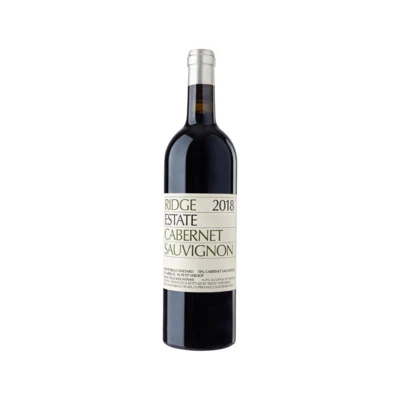
Ridge Vineyards - Estate Santa Cruz Mountains Cabernet Sauvingon 2019
In 1962, Ridge made its first Monte Bello, and two years later its first zinfandel. Since that time, Ridge has championed single-vineyard winemaking, searching California for those rare and exceptional vineyards where climate, soil, and variety are ideally matched.
The history of Ridge Vineyards begins in 1885, when Osea Perrone, a doctor who became a prominent member of San Francisco’s Italian community, bought 180 acres near the top of Monte Bello Ridge. He terraced the slopes and planted vineyards. Using native limestone, he constructed the Monte Bello Winery, producing the first vintage under that name in 1892. This unique cellar, built into the mountainside on three levels, is Ridge’s production facility. At 2,600 feet above sea level, it is surrounded by the “upper vineyard”, now referred to as the Perrone Ranch.
William Short bought the abandoned winery below the Perrone Ranch as well as the winery and replanted several plots to Cabernet in the 1940s. A group of research engineers from the Stanford Research Institute subsequently bought the property and started making wine. The quality of the ‘60 and ‘61 vintages led to a re-bonding of the property for the ‘62 vintage, and one of the owners, Dave Bennion, left his job at SRI to oversee winemaking full-time.
The first Zinfandel was made in 1964, and in 1966, the first Geyserville Zinfandel. The vineyard was expanded to 45 acres. The Perrone Ranch was bought in 1967, bringing the original property back to its original footprint. Cabernet and Zinfandel account for most of the production; Syrah, Grenache, Carignan, and Petite Syrah constitute a small percentage. Known primarily for its red wines, Ridge has also made limited amounts of Chardonnay since 1962.
Paul Draper joined in 1968 right after returning from setting up a winery in Chile. The traditional methods championed by Paul, coupled with the “hands off” approach that had been the hallmark at Ridge, quickly established Ridge‘s reputation in the domestic and international markets for wine of consistent quality. They call their approach “pre-industrial” winemaking: Ridge want for wines to make themselves–this can happen when sites are chosen carefully, vines are monitored closely, natural ground cover sustained, organic fertilizers employed, and wild yeasts used for fermentation. All the key decisions during the winemaking process are done through blind tests: blending, pumping for tanning extraction, length of fermentation. Any additives used are listed on the label, in the pursuit of transparency with the consumer.
Product Information
Product Information
Shipping & Returns
Shipping & Returns
Description
In 1962, Ridge made its first Monte Bello, and two years later its first zinfandel. Since that time, Ridge has championed single-vineyard winemaking, searching California for those rare and exceptional vineyards where climate, soil, and variety are ideally matched.
The history of Ridge Vineyards begins in 1885, when Osea Perrone, a doctor who became a prominent member of San Francisco’s Italian community, bought 180 acres near the top of Monte Bello Ridge. He terraced the slopes and planted vineyards. Using native limestone, he constructed the Monte Bello Winery, producing the first vintage under that name in 1892. This unique cellar, built into the mountainside on three levels, is Ridge’s production facility. At 2,600 feet above sea level, it is surrounded by the “upper vineyard”, now referred to as the Perrone Ranch.
William Short bought the abandoned winery below the Perrone Ranch as well as the winery and replanted several plots to Cabernet in the 1940s. A group of research engineers from the Stanford Research Institute subsequently bought the property and started making wine. The quality of the ‘60 and ‘61 vintages led to a re-bonding of the property for the ‘62 vintage, and one of the owners, Dave Bennion, left his job at SRI to oversee winemaking full-time.
The first Zinfandel was made in 1964, and in 1966, the first Geyserville Zinfandel. The vineyard was expanded to 45 acres. The Perrone Ranch was bought in 1967, bringing the original property back to its original footprint. Cabernet and Zinfandel account for most of the production; Syrah, Grenache, Carignan, and Petite Syrah constitute a small percentage. Known primarily for its red wines, Ridge has also made limited amounts of Chardonnay since 1962.
Paul Draper joined in 1968 right after returning from setting up a winery in Chile. The traditional methods championed by Paul, coupled with the “hands off” approach that had been the hallmark at Ridge, quickly established Ridge‘s reputation in the domestic and international markets for wine of consistent quality. They call their approach “pre-industrial” winemaking: Ridge want for wines to make themselves–this can happen when sites are chosen carefully, vines are monitored closely, natural ground cover sustained, organic fertilizers employed, and wild yeasts used for fermentation. All the key decisions during the winemaking process are done through blind tests: blending, pumping for tanning extraction, length of fermentation. Any additives used are listed on the label, in the pursuit of transparency with the consumer.