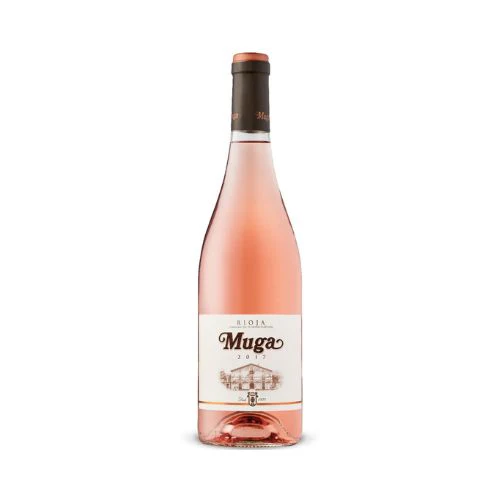
Muga - Rioja Rosado 2024
Traditional Rioja, quite naturally enough, has a great following. The synergy of values and history is self-evident and the wines are some of the most distinctive and under-rated in Europe. When one visits the area around the old railway station at Haro, one is overwhelmed by the role-call of great names, all located in close proximity to one another, all famous names: López Heredia, Marqués de Riscal, Marqués de Cáceres, Marqués de Murrieta, and several others. Bodega Muga certainly belongs in this list.
Bodega Muga was founded in Haro in 1932 and is still in the family. the company farms 250 hectares in La Rioja Alta and in addition has long-standing contracts with the owners of another 150 hectares. Located in the foothills of the Montes Obarenses, the five main vineyards (El Estepal, La Loma, Blatracones, La Loma Alta, and Sajazarra) share clay and limestone soils, each with its own unique microclimate, informed by the happy coincidence of continental, Mediterranean and Atlantic influences. The extended Muga family controls all aspects of the production and advocates for the complexity afforded by the entire canon of grapes, that is to say Tempranillo, of course for the red, but also Garnacha, Mazuelo and Graciano in addition to Viura and Malvasia for the whites.
The key to everything here is wood, from the magnificent 18th century wooden Bodega to the impressive collection of 14,000 barrels used for maturation. In addition, the wines are fermented in large wooden casks, of which there were 90, all of subtly differing sizes, at the last count. An in-house Cooperage employs three experts full time in addition to a Cubero, a specialist who makes and maintains the large casks. It should come as no surprise that vinification is traditional with wines naturally undergoing malolactic fermentation, and with racking every four months and fining with egg-whites. The residual egg-whites, together with the discarded lees go to make up a high quality compost, which serves as an organically sustainable fertilizer. And so the whole process resumes, nourishing itself as it will surely nourish those who sample their most impressive range.
Bodegas Muga has their wines age in cask between 24 and 36 months, depending on the wine. Further aging takes place in bottle: 9 months for Crianza, and 36 months for Gran Reservas. Bodega Muga wines, while capable of aging in the cellar, can be enjoyed immediately.
Product Information
Product Information
Shipping & Returns
Shipping & Returns
Description
Traditional Rioja, quite naturally enough, has a great following. The synergy of values and history is self-evident and the wines are some of the most distinctive and under-rated in Europe. When one visits the area around the old railway station at Haro, one is overwhelmed by the role-call of great names, all located in close proximity to one another, all famous names: López Heredia, Marqués de Riscal, Marqués de Cáceres, Marqués de Murrieta, and several others. Bodega Muga certainly belongs in this list.
Bodega Muga was founded in Haro in 1932 and is still in the family. the company farms 250 hectares in La Rioja Alta and in addition has long-standing contracts with the owners of another 150 hectares. Located in the foothills of the Montes Obarenses, the five main vineyards (El Estepal, La Loma, Blatracones, La Loma Alta, and Sajazarra) share clay and limestone soils, each with its own unique microclimate, informed by the happy coincidence of continental, Mediterranean and Atlantic influences. The extended Muga family controls all aspects of the production and advocates for the complexity afforded by the entire canon of grapes, that is to say Tempranillo, of course for the red, but also Garnacha, Mazuelo and Graciano in addition to Viura and Malvasia for the whites.
The key to everything here is wood, from the magnificent 18th century wooden Bodega to the impressive collection of 14,000 barrels used for maturation. In addition, the wines are fermented in large wooden casks, of which there were 90, all of subtly differing sizes, at the last count. An in-house Cooperage employs three experts full time in addition to a Cubero, a specialist who makes and maintains the large casks. It should come as no surprise that vinification is traditional with wines naturally undergoing malolactic fermentation, and with racking every four months and fining with egg-whites. The residual egg-whites, together with the discarded lees go to make up a high quality compost, which serves as an organically sustainable fertilizer. And so the whole process resumes, nourishing itself as it will surely nourish those who sample their most impressive range.
Bodegas Muga has their wines age in cask between 24 and 36 months, depending on the wine. Further aging takes place in bottle: 9 months for Crianza, and 36 months for Gran Reservas. Bodega Muga wines, while capable of aging in the cellar, can be enjoyed immediately.