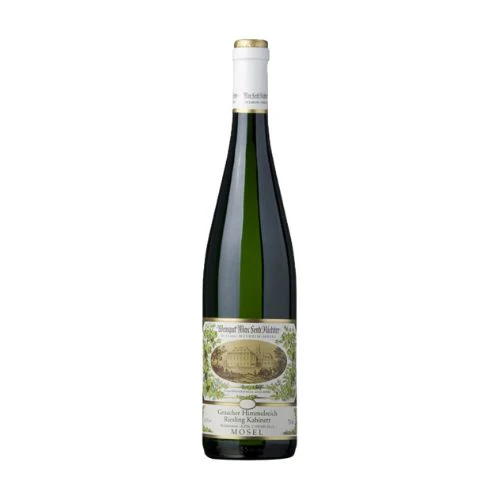
Max Ferd. Richter - Graacher Himmelreich Riesling Kabinett 2022
The estate of Max Ferdinand Richter has been passed down from father to son for the past 300 years. The current reins are held by Dr. Dirk Richter, the 9th generation, and will eventually be passed down to his son Constantin. Max Ferdinand Richter produces world-class Rieslings from some of the most esteemed vineyards in the Mosel, and all production comes from estate holdings. Additionally, they produce wine from two top monopole vineyards: Mülheimer Helenenkloster and Veldenzer Elisenberg. Mülheimer Helenenkloster is considered by many to be among the best Eiswein vineyards in Germany.
The ownership of Veldenzer Elisenberg dates back to 1813 when ancestor Franz Ludwig Niessen found out that Napoleon Bonaparte planned on uprooting the beloved Veldenz and Mulheim vineyards, and negotiated a personal payment to the General to prevent him from destroying the vineyards. As thanks, the town gave him the entire slope of Veldenzer Elisenberg and it has remained in the family ever since.
The terroir of their steep vineyard sites is generally grey slate with different compositions of ferruginous (Brauneberg), mineral quartz (Veldenz) or clay (Graach, Wehlen, Mülheim) soils; those deeply influence character and flavor of the wines.
In order to reduce quantity and increase concentration, pruning is severe, and in prolific years a green harvest is carried out in August. The vintage is picked much later than that of most growers and is done entirely by hand. Three passes are done to select the best qualities to eliminate all inferior grapes and to keep perfect botrytis bunches or single berries for Auslese qualities and above. The same attention is paid to all vines from the QBAs on up through the Eisweins. Through the entire line of wines, their hallmark balance is evident in every glass.
Vinification starts with gentle pressing and slow temperature controlled fermentation in traditional old oak barrels (fuders). This careful, deliberate process preserves the quality of the grapes, develops the unique character of the single-vineyard cuvees, and gives the wine exceptional longevity.
Original: $36.73
-65%$36.73
$12.86Product Information
Product Information
Shipping & Returns
Shipping & Returns
Description
The estate of Max Ferdinand Richter has been passed down from father to son for the past 300 years. The current reins are held by Dr. Dirk Richter, the 9th generation, and will eventually be passed down to his son Constantin. Max Ferdinand Richter produces world-class Rieslings from some of the most esteemed vineyards in the Mosel, and all production comes from estate holdings. Additionally, they produce wine from two top monopole vineyards: Mülheimer Helenenkloster and Veldenzer Elisenberg. Mülheimer Helenenkloster is considered by many to be among the best Eiswein vineyards in Germany.
The ownership of Veldenzer Elisenberg dates back to 1813 when ancestor Franz Ludwig Niessen found out that Napoleon Bonaparte planned on uprooting the beloved Veldenz and Mulheim vineyards, and negotiated a personal payment to the General to prevent him from destroying the vineyards. As thanks, the town gave him the entire slope of Veldenzer Elisenberg and it has remained in the family ever since.
The terroir of their steep vineyard sites is generally grey slate with different compositions of ferruginous (Brauneberg), mineral quartz (Veldenz) or clay (Graach, Wehlen, Mülheim) soils; those deeply influence character and flavor of the wines.
In order to reduce quantity and increase concentration, pruning is severe, and in prolific years a green harvest is carried out in August. The vintage is picked much later than that of most growers and is done entirely by hand. Three passes are done to select the best qualities to eliminate all inferior grapes and to keep perfect botrytis bunches or single berries for Auslese qualities and above. The same attention is paid to all vines from the QBAs on up through the Eisweins. Through the entire line of wines, their hallmark balance is evident in every glass.
Vinification starts with gentle pressing and slow temperature controlled fermentation in traditional old oak barrels (fuders). This careful, deliberate process preserves the quality of the grapes, develops the unique character of the single-vineyard cuvees, and gives the wine exceptional longevity.