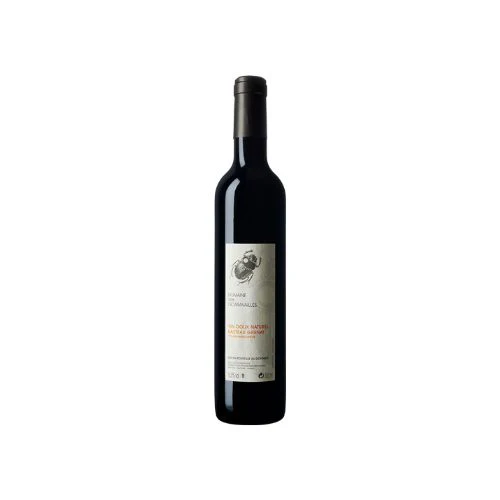
Domaine des Escaravailles - Vin Doux Naturel Rasteau Grenat 2022
The Domaine des Escaravailles has been owned by the Ferran family for three generations. Founded in 1953 by Jean-Louis Ferran and his sons Daniel and Jean-Pierre, it is currently managed since 1999 by Gilles, Daniel’s son. The estate owes its name to the Occitan word escaravay, which means beetle. This nickname was given by the inhabitants of the village to the Pénitents Noirs of Avignon, owners at the time (archives of Rasteau, 1623).
The vineyards cover 40 hectares in the top of Rasteau on stony, sloping clay-limestone slopes and 25 hectares on the neighbouring terroirs of Cairanne, Roaix, Villedieu and Saint Roman de Malegarde. The elevation brings freshness to the wines and establishes a fine counterpoint to the characteristic maturity of Rasteau. Their vines in Rasteau enjoy slightly cooler nights and a slightly later ripening than the rest of the vineyard. All of this results in wines that are fruit-bearing but also elegant and fresh.
The vines are cultivated in the traditional way with plowing and organic fertilizers. The harvest is essentially manual with manual sorting. The grapes are then destemmed, vinified and aged in the highest semi-buried cellar of Rasteau, located in the heart of the vineyard.
Product Information
Product Information
Shipping & Returns
Shipping & Returns
Description
The Domaine des Escaravailles has been owned by the Ferran family for three generations. Founded in 1953 by Jean-Louis Ferran and his sons Daniel and Jean-Pierre, it is currently managed since 1999 by Gilles, Daniel’s son. The estate owes its name to the Occitan word escaravay, which means beetle. This nickname was given by the inhabitants of the village to the Pénitents Noirs of Avignon, owners at the time (archives of Rasteau, 1623).
The vineyards cover 40 hectares in the top of Rasteau on stony, sloping clay-limestone slopes and 25 hectares on the neighbouring terroirs of Cairanne, Roaix, Villedieu and Saint Roman de Malegarde. The elevation brings freshness to the wines and establishes a fine counterpoint to the characteristic maturity of Rasteau. Their vines in Rasteau enjoy slightly cooler nights and a slightly later ripening than the rest of the vineyard. All of this results in wines that are fruit-bearing but also elegant and fresh.
The vines are cultivated in the traditional way with plowing and organic fertilizers. The harvest is essentially manual with manual sorting. The grapes are then destemmed, vinified and aged in the highest semi-buried cellar of Rasteau, located in the heart of the vineyard.