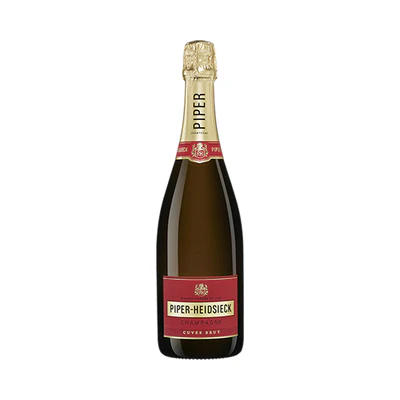
Champagne Piper Heidsieck - Cuvée Brut
The oldest of the three Heidsieck champagne houses, Piper-Heidsieck was founded in 1785 by Florens-Louis Heidsieck. Ambitious to make his mark, Florens-Louis created a cuvée which he presented in person to Queen Marie-Antoinette; a patronage that one assumes was, at a certain point, abruptly severed. Upon his death, Florens-Louis’ nephew Christian Heidsieck went into partnership with Henri-Guillaume Piper, an energetic entrepreneur who did much to champion champagne throughout the world. Christian died suddenly, with his widow marrying Henri- Guillaume and the company becoming known as Piper-Heidsieck.
Piper-Heidsieck is today owned by the French Descours family, who truly champion the wines and have a commitment to the community, having become a Certified B Corportation. Piper-Heidsieck has embraced sustainability: half of the vineyards are already weeded without herbicides, with the goal of improving during the next 10 years. Tradicional cultivation practices are followed, the growers have become integrated into the operation, and there is a strong preference for local providers.
The rejuvenation of Piper Heidsieck was begun by Daniel Thibault, who died young in 2002. The current Chef de Cave, Regis Camus, worked with Daniel and has continued to direct Piper’s impressive evolution. At four million bottles Piper-Heidsieck is one of the top ten producers in terms of volume. The house quality is at an all time high, with more potentially to come. Their prestige cuvée, Rare, was first launched in 1976, and since then the wine has lived up to its name, with the 2006 vintage just the ninth to be released. A hidden gem in the range is the Piper-Heidsieck Vintage–derived from 20 Grand and Premier Cru vineyards.
Harvest takes place by hand: bunches of grapes are picked and transported in special crates to the nearest press. Pressing takes place cru by cru, variety by variety. Immediately after pressing, the musts are placed in vats for 15 to 20 hours so that all residue deposits at the bottom. The clear juice is transferred to the Piper-Heidsieck winery. The fermentation takes place in two stages: natural alcoholic fermentation in steel vats for two weeks, resulting in vin clairs. Then, malolactic fermentation takes place. Although this second fermentation is optional in Champagne, Piper-Heidsieck believes it is crucial for their wines. The vins clairs are sampled repeatedly during the fermentation process to identify candidate blends. Reserve wines from prior years are also considered. The blends are bottled, and liqueur de tirage is added to the still wine so that it undergoes a secondary alcoholic fermentation. Then the wines sit in the cellar. Non-vintage cuvees will be in the cellar from 2 to 3 years; Sublime and Essential age for 4 years, with 6 years for vintage cuvees, and 8 to 10 years for the Cuvee Rare. The bottles are riddled and disgorged. At this last step, a small amount of liqueur d’expédition will be added that will determine the dryness of the wine.
Original: $57.30
-65%$57.30
$20.05Product Information
Product Information
Shipping & Returns
Shipping & Returns
Description
The oldest of the three Heidsieck champagne houses, Piper-Heidsieck was founded in 1785 by Florens-Louis Heidsieck. Ambitious to make his mark, Florens-Louis created a cuvée which he presented in person to Queen Marie-Antoinette; a patronage that one assumes was, at a certain point, abruptly severed. Upon his death, Florens-Louis’ nephew Christian Heidsieck went into partnership with Henri-Guillaume Piper, an energetic entrepreneur who did much to champion champagne throughout the world. Christian died suddenly, with his widow marrying Henri- Guillaume and the company becoming known as Piper-Heidsieck.
Piper-Heidsieck is today owned by the French Descours family, who truly champion the wines and have a commitment to the community, having become a Certified B Corportation. Piper-Heidsieck has embraced sustainability: half of the vineyards are already weeded without herbicides, with the goal of improving during the next 10 years. Tradicional cultivation practices are followed, the growers have become integrated into the operation, and there is a strong preference for local providers.
The rejuvenation of Piper Heidsieck was begun by Daniel Thibault, who died young in 2002. The current Chef de Cave, Regis Camus, worked with Daniel and has continued to direct Piper’s impressive evolution. At four million bottles Piper-Heidsieck is one of the top ten producers in terms of volume. The house quality is at an all time high, with more potentially to come. Their prestige cuvée, Rare, was first launched in 1976, and since then the wine has lived up to its name, with the 2006 vintage just the ninth to be released. A hidden gem in the range is the Piper-Heidsieck Vintage–derived from 20 Grand and Premier Cru vineyards.
Harvest takes place by hand: bunches of grapes are picked and transported in special crates to the nearest press. Pressing takes place cru by cru, variety by variety. Immediately after pressing, the musts are placed in vats for 15 to 20 hours so that all residue deposits at the bottom. The clear juice is transferred to the Piper-Heidsieck winery. The fermentation takes place in two stages: natural alcoholic fermentation in steel vats for two weeks, resulting in vin clairs. Then, malolactic fermentation takes place. Although this second fermentation is optional in Champagne, Piper-Heidsieck believes it is crucial for their wines. The vins clairs are sampled repeatedly during the fermentation process to identify candidate blends. Reserve wines from prior years are also considered. The blends are bottled, and liqueur de tirage is added to the still wine so that it undergoes a secondary alcoholic fermentation. Then the wines sit in the cellar. Non-vintage cuvees will be in the cellar from 2 to 3 years; Sublime and Essential age for 4 years, with 6 years for vintage cuvees, and 8 to 10 years for the Cuvee Rare. The bottles are riddled and disgorged. At this last step, a small amount of liqueur d’expédition will be added that will determine the dryness of the wine.