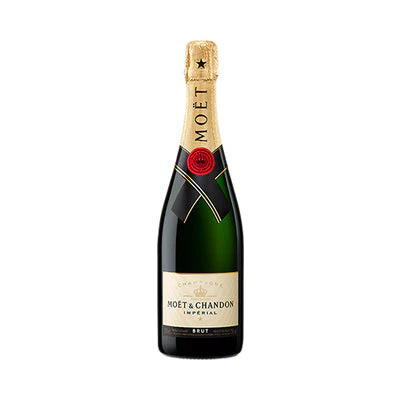
Champagne Moet & Chandon - Imperial Brut
Moët et Chandon began as Moët et Cie, established by Épernay wine trader Claude Moët in 1743, and began shipping his wine from Champagne to Paris. The reign of King Louis XV coincided with increased demand for sparkling wine. Soon after its founding, and after son Claude-Louis joined Moët et Cie, the winery’s clientele included nobles and aristocrats.
In 1833, the company was renamed Moët et Chandon after Pierre-Gabriel Chandon de Briailles, Remy Moët’s son-in-law, joined the company as a partner of Jean-Remy Moët, Claude Moët’s grandson.
Following the introduction of the concept of a vintage champagne in 1840, Moët et Chandon marketed its first vintage in 1842. Their best-selling brand, Brut Imperial, was introduced in the 1860s. Their best known label, Dom Perignon, is named for the Benedictine monk remembered in legend as the “Father of Champagne”. The brand was owned by Champagne Mercier but was given to Moët in 1927.
Moët et Chandon has the most extensive estate in the region: 2,840 hectares, out of which about half are Grand Crus and a quarter are Premier Crus. The domaine grows the classic trio of Chardonnay, Pinot Noir, and Pinot Meunier, with each contributing to the qualities of the wines: Chardonnay is elegant, acidic, fresh, with notes of citrus fruit and white flowers; Pinot Noir has body and provides structure and intensity, with berry notes; Pinot Meunier gives some blends their suppleness, roundness, and body, with notes of white-fleshed fruits.
Harvesting is done by hand, with a crew of 3,500 pickers, who select only the ripest fruit, which is then hand-sorted. Blending is done by selecting the right proportion from over 800 base wines by a panel of 10 oenologists, with the cellar master making the final decision. This process ensures both the highest quality and consistency from vintage to vintage.
Maturation takes place in the bottle. Moët et Chandon has over 28 km of cellars in the ground below Epernay, with a temperature between 10 to 12 °C. For the more select cuvees, riddling and disgorgement is done by hand.
Original: $58.77
-65%$58.77
$20.57Product Information
Product Information
Shipping & Returns
Shipping & Returns
Description
Moët et Chandon began as Moët et Cie, established by Épernay wine trader Claude Moët in 1743, and began shipping his wine from Champagne to Paris. The reign of King Louis XV coincided with increased demand for sparkling wine. Soon after its founding, and after son Claude-Louis joined Moët et Cie, the winery’s clientele included nobles and aristocrats.
In 1833, the company was renamed Moët et Chandon after Pierre-Gabriel Chandon de Briailles, Remy Moët’s son-in-law, joined the company as a partner of Jean-Remy Moët, Claude Moët’s grandson.
Following the introduction of the concept of a vintage champagne in 1840, Moët et Chandon marketed its first vintage in 1842. Their best-selling brand, Brut Imperial, was introduced in the 1860s. Their best known label, Dom Perignon, is named for the Benedictine monk remembered in legend as the “Father of Champagne”. The brand was owned by Champagne Mercier but was given to Moët in 1927.
Moët et Chandon has the most extensive estate in the region: 2,840 hectares, out of which about half are Grand Crus and a quarter are Premier Crus. The domaine grows the classic trio of Chardonnay, Pinot Noir, and Pinot Meunier, with each contributing to the qualities of the wines: Chardonnay is elegant, acidic, fresh, with notes of citrus fruit and white flowers; Pinot Noir has body and provides structure and intensity, with berry notes; Pinot Meunier gives some blends their suppleness, roundness, and body, with notes of white-fleshed fruits.
Harvesting is done by hand, with a crew of 3,500 pickers, who select only the ripest fruit, which is then hand-sorted. Blending is done by selecting the right proportion from over 800 base wines by a panel of 10 oenologists, with the cellar master making the final decision. This process ensures both the highest quality and consistency from vintage to vintage.
Maturation takes place in the bottle. Moët et Chandon has over 28 km of cellars in the ground below Epernay, with a temperature between 10 to 12 °C. For the more select cuvees, riddling and disgorgement is done by hand.