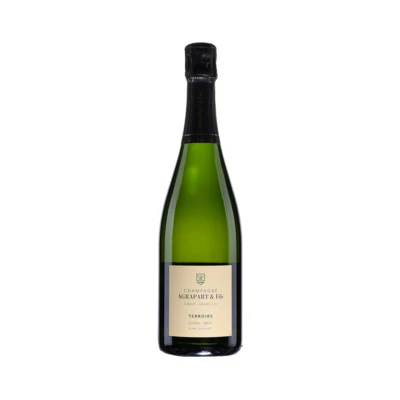
Champagne Agrapart - Terroirs Grand Cru Extra Brut Blanc de Blancs
The Champagne house of Agrapart et Fils is located in the celebrated village of Avize in the heart of the Côte de Blancs. The estate was established in 1894, yet unlike many of the smaller grower Champagne houses that have only begun to estate bottle under their own labels in recent decades, the Agrapart family has done so since the inception of the domaine. The winery was founded by Arthur Agrapart, and is now run by the fourth generation of the family.
Pascal Agrapart took over in 1984 over Champagne Agrapart, which dates back to the late 19th century. It’s a ten hectare estate that comprises more than 60 small parcels predominantly in the Grand Cru villages of Avize, Cramant, Oiry, and Oger (though the 7 Crus bottling incorporates three 1er Crus as well). Pascal’s oldest son Amboise recently joined his father, helping him manage the vineyard.
To ensure the highest possible quality, production has always been kept at an artisanal level, with quantities of no more than 5,400 cases produced in any given year. Vine age is among the oldest in the Côte de Blancs, with many of the Agrapart’s vineyards in excess of seventy years of age, and the average overall age of the vines is a healthy forty years old.
The changes Pascal has wrought at the Domaine include using more manual methods in the vineyard and cellar; he works the soil by hand and has ceased using chemicals in the vineyards, though he has no plans to become certified organic as he prefers to retain the right to treat if necessary. In the cellar, all base wines are fermented with native yeast, which is uncommon in Champagne, where many very good growers will resort to cultured yeast if fermentation doesn’t start spontaneously.
Their Champagne wines are neither fined nor filtered. Bottling takes place at the domain and the bottles are hand-riddled. Champagne Agrapart uses wood in the cellar for his top wines, preferring older barrels that do not impart oaky flavors to the wines. In fact, Champagne Agrapart’s base wines (vins clairs) taste very much like finished wines; this is a fantastic harbinger of what’s to come once the second fermentation and lees aging are finished.
Product Information
Product Information
Shipping & Returns
Shipping & Returns
Description
The Champagne house of Agrapart et Fils is located in the celebrated village of Avize in the heart of the Côte de Blancs. The estate was established in 1894, yet unlike many of the smaller grower Champagne houses that have only begun to estate bottle under their own labels in recent decades, the Agrapart family has done so since the inception of the domaine. The winery was founded by Arthur Agrapart, and is now run by the fourth generation of the family.
Pascal Agrapart took over in 1984 over Champagne Agrapart, which dates back to the late 19th century. It’s a ten hectare estate that comprises more than 60 small parcels predominantly in the Grand Cru villages of Avize, Cramant, Oiry, and Oger (though the 7 Crus bottling incorporates three 1er Crus as well). Pascal’s oldest son Amboise recently joined his father, helping him manage the vineyard.
To ensure the highest possible quality, production has always been kept at an artisanal level, with quantities of no more than 5,400 cases produced in any given year. Vine age is among the oldest in the Côte de Blancs, with many of the Agrapart’s vineyards in excess of seventy years of age, and the average overall age of the vines is a healthy forty years old.
The changes Pascal has wrought at the Domaine include using more manual methods in the vineyard and cellar; he works the soil by hand and has ceased using chemicals in the vineyards, though he has no plans to become certified organic as he prefers to retain the right to treat if necessary. In the cellar, all base wines are fermented with native yeast, which is uncommon in Champagne, where many very good growers will resort to cultured yeast if fermentation doesn’t start spontaneously.
Their Champagne wines are neither fined nor filtered. Bottling takes place at the domain and the bottles are hand-riddled. Champagne Agrapart uses wood in the cellar for his top wines, preferring older barrels that do not impart oaky flavors to the wines. In fact, Champagne Agrapart’s base wines (vins clairs) taste very much like finished wines; this is a fantastic harbinger of what’s to come once the second fermentation and lees aging are finished.